They Said the Cloud Was Too Risky. Now They're Saying the Same About Vibeware.
Why developer skepticism about AI feels remarkably familiar, and why the objections may be exactly what makes the next generation of software better.
By Greg Marmulak · 2026-11-02
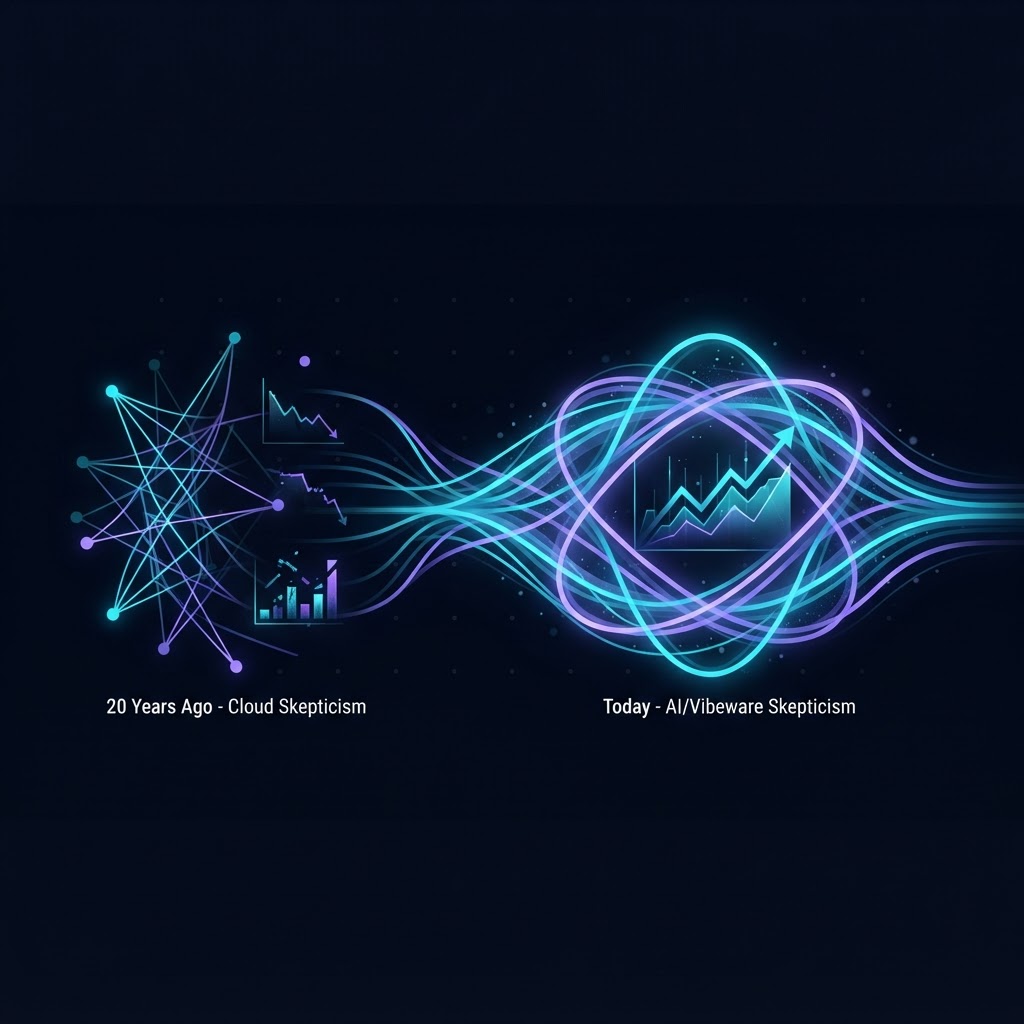
I keep hearing something about AI-generated software that takes me back about 20 years.
"You can't trust it."
"It's not secure enough."
"It's not reliable enough for enterprise customers."
"You should never sell software built this way."
These comments sound remarkably familiar.
Not because I haven't heard them before about AI, but because I remember hearing almost exactly the same arguments when cloud computing started challenging traditional enterprise IT.
And having lived through that transition, I can't help wondering:
Are we watching history repeat itself?
I Remember When the Cloud Was Never Going to Work
Twenty years ago, I spent a lot of time talking with IT teams about enterprise software and the emerging possibilities of cloud computing.
And I remember the resistance.
Some of it was incredibly strong.
I had IT professionals tell me that large enterprises, particularly Fortune 500 companies, would never move critical applications and data to the cloud.
The security risks were too great.
The reliability wasn't there.
Companies couldn't surrender control of their infrastructure.
No responsible IT organization would trust an outside provider with something so important.
At the time, those concerns weren't entirely unreasonable.
Cloud platforms were still maturing. Security practices were evolving. Connectivity, availability, regulatory requirements, and operational controls needed to improve.
But something interesting happened.
The cloud didn't disappear because the critics identified legitimate weaknesses.
It got better.
Providers invested in security, redundancy, encryption, monitoring, compliance, disaster recovery, and operational resilience.
Businesses developed new governance practices and learned how to operate in a shared-responsibility environment.
And over time, cloud computing became foundational to modern enterprise technology.
Today, some of the same organizations that once considered the cloud too risky depend on it for their most important business operations.
The technology didn't succeed because the objections were wrong. It succeeded, in part, because the industry was forced to overcome them.
And I think we're watching something very similar happen with AI and Vibeware.
The New Argument: AI-Generated Software Isn't Real Software
Spend enough time following discussions about AI-assisted software development, and you'll encounter some remarkably strong opinions.
AI-generated code is unreliable.
It creates security vulnerabilities.
It produces applications that work in a demonstration but fall apart under real-world conditions.
People who don't understand software engineering shouldn't be building applications for customers.
And one of my favorites:
"You should never sell Vibeware to a customer."
Now, I understand where some of this comes from.
Software engineering is difficult. Building reliable systems involves considerably more than creating a working interface.
Security, architecture, testing, scalability, data integrity, integration reliability, maintainability, and operational support all matter.
And AI doesn't magically eliminate those responsibilities.
But here's what I find interesting.
Why do we assume those responsibilities can only be fulfilled through traditional software development?
If the application is secure, the functionality is validated, the business rules are correct, the tests pass, the infrastructure is reliable, and the system performs as expected, why should the method used to produce the code determine whether the software is legitimate?
Shouldn't the quality of the outcome matter more than the process that created it?
I think that's the question we should be asking.
We're Learning Something Very Different by Actually Building
At ForecastWorx, we've embraced AI as a fundamental part of how we build software.
Not simply as a coding assistant that occasionally helps write a function.
AI is involved throughout our development process, helping us explore business requirements, evaluate alternatives, design functionality, create code, identify defects, test changes, and continually improve the platform.
And it has fundamentally changed what we're capable of accomplishing.
We're building functionality that traditionally would have required substantially more development resources, time, and expense.
We're experimenting with ideas that might never have justified the cost of a conventional development project.
And we're learning at a pace that I wouldn't have believed possible a few years ago.
But perhaps more importantly, we're learning what AI is good at.
And what it isn't.
We've discovered where it needs more context, where it can make incorrect assumptions, where generated code requires closer scrutiny, and why testing and validation remain essential.
We've learned that a compelling interface doesn't mean the underlying business logic is correct.
We've learned that software can appear to work perfectly while hiding problems that only become apparent through deeper testing.
And we've learned that being able to build something quickly doesn't eliminate the responsibility to build it properly.
These lessons didn't come from debating whether Vibeware could work. They came from making it work.
That's an important distinction.
Because the earlier you begin working with a technology, the earlier you start developing an understanding of its real capabilities and limitations.
And that knowledge compounds.
What If the Critics Are Part of the Reason This Will Succeed?
Here's where my perspective might surprise some people.
Even though I disagree with much of the blanket criticism directed at Vibeware, I actually appreciate the people raising difficult questions.
Because I believe they're helping make the technology better.
Think about cloud computing.
If IT professionals hadn't demanded stronger security, better availability, more transparent controls, and clearer accountability, would cloud platforms have evolved as effectively as they did?
Perhaps eventually.
But the pressure from customers, security professionals, regulators, and enterprise architects helped establish the standards that made widespread adoption possible.
I suspect the same thing will happen with AI-generated software.
Developers are asking important questions.
How do we prevent AI from introducing security vulnerabilities?
How do we validate complex business logic?
How do we maintain applications when significant portions of the code were generated by AI?
How do we understand and troubleshoot systems we didn't write line by line?
How do we ensure changes don't break existing functionality?
How do we create software that customers can depend on?
Those are all legitimate questions.
And the industry needs to answer them.
But there's a big difference between identifying what a technology must improve and declaring that the technology should never be used.
One position moves us forward.
The other risks keeping us tied to the past.
Maybe We're Confusing Today's Limitations With Tomorrow's Possibilities
One of the things I find most fascinating about technology resistance is how often we evaluate an emerging technology as though its current limitations are permanent.
We look at what it can't do today and conclude that it will never be ready.
But technologies evolve.
AI models are improving. Development tools are becoming more capable. Testing and verification practices are advancing. Security tooling is adapting to the new development environment.
And AI-assisted development is increasingly becoming an integrated process rather than simply asking a chatbot to generate code.
That doesn't mean every new model is automatically more reliable or that every problem will eventually disappear.
Some risks may remain difficult, and others will emerge as the technology becomes more powerful.
But does anyone seriously believe that AI's ability to develop software has reached its peak?
I certainly don't.
And that's why I'm so enthusiastic about adopting it now.
We're not simply benefiting from what AI can accomplish today.
We're developing the knowledge, experience, processes, and judgment that will allow us to take advantage of everything it becomes capable of tomorrow.
That's an enormous competitive advantage.
Is Waiting Really the Safer Strategy?
This is the question I think more businesses should be asking.
When a new technology emerges, the instinct is often to wait until it's mature.
Wait until it's proven.
Wait until the risks are understood.
Wait until someone else has figured it out.
And in certain situations, that absolutely makes sense.
You don't experiment recklessly with critical financial transactions, sensitive customer data, or systems where failure could cause serious harm.
But there's a difference between managing risk and avoiding learning.
If you wait until a technology is completely mature before you begin exploring it, you may eliminate some early adoption challenges.
But you also miss the experience that comes from participating in its evolution.
You miss the opportunity to influence how it develops.
You miss the discoveries that come from testing its boundaries.
And you miss the compounding benefit of everything you learn along the way.
We've experienced this firsthand.
Every challenge we encounter while building ForecastWorx teaches us something.
Every limitation forces us to improve our approach.
Every new capability opens opportunities we hadn't previously considered.
And every improvement becomes part of how we build the next thing.
That learning has become one of our most valuable assets.
The biggest risk of waiting isn't necessarily being late to adopt AI. It's being late to understand it.
And understanding is something you can't simply purchase when you finally decide you're ready.
The Developer's Role Isn't Disappearing. It's Changing.
I also think some of the resistance comes from an understandable concern about how AI is changing the software development profession.
For decades, developers have been the people who translate business requirements into functioning applications.
Their expertise has been essential because building software required specialized technical knowledge.
Now, AI is changing how much of that work gets accomplished.
People who couldn't have developed sophisticated applications independently a few years ago can now participate directly in creating them.
That changes the relationship between business expertise and technical expertise.
And I can understand why that might feel uncomfortable.
But I don't see this as the end of software engineering.
I see it as an opportunity to redefine where engineering expertise creates the most value.
Instead of spending so much effort manually producing code, developers can increasingly focus on architecture, security, validation, system reliability, performance, and solving the hardest technical problems.
Their judgment becomes more important, not less.
Because generating code and engineering a trustworthy product are two different things.
AI may dramatically reduce the effort required for the first.
But the second still demands discipline, accountability, and an understanding of the consequences when something goes wrong.
The future doesn't have to be business people versus developers. It can be business expertise and engineering expertise working together with AI to create better software.
And frankly, that seems like a much more exciting future for everyone involved.
Vibeware Doesn't Mean Abandoning Discipline
There's another misconception I think we need to challenge.
Some people hear the word Vibeware and assume it means building applications without structure, testing, documentation, or accountability.
As though the entire development process consists of describing an idea to AI, generating an application, and immediately selling it to customers.
If that's the approach, I understand the criticism.
But that isn't what Vibeware has to be.
For us, Vibeware is about fundamentally changing how software is conceived, created, tested, and continuously improved.
It doesn't mean abandoning the standards that make software dependable.
It means using AI to help us achieve those standards more efficiently.
We still need version control, testing, validation, security controls, release management, monitoring, and a clear understanding of how the system operates.
We still have to protect customer data.
We still have to verify that business calculations are accurate.
We still have to make sure the platform performs reliably.
And ultimately, we're still accountable for what we deliver.
AI doesn't remove that responsibility.
It gives us a new way to fulfill it.
That's a distinction I wish more conversations about AI-generated software would recognize.
The question shouldn't be whether an application was built with AI.
The question should be whether it was built responsibly and whether it delivers what customers need.
What Will We Think About This Conversation in 20 Years?
I keep coming back to the conversations I had with IT teams two decades ago.
The certainty that cloud computing would never be secure enough.
The conviction that major enterprises would never trust it.
The belief that the risks were simply too great.
Looking back, some of those conversations seem almost amusing.
But I also recognize that the concerns raised during that period helped shape the cloud services we trust today.
And I wonder whether we'll have the same perspective on AI-generated software in 20 years.
Will we look back and find it strange that people questioned whether AI could be trusted to build commercial applications?
Will software developed primarily by humans seem as unusual as a company operating all its own physical servers might seem to a cloud-first startup today?
Or will we recognize that the skepticism, uncomfortable questions, and demanding technical standards were necessary steps toward making AI-generated software reliable enough for everyone?
My suspicion is that both will be true.
We'll probably smile at some of the absolute declarations about what AI could never accomplish.
And we'll be grateful that people challenged its weaknesses before those weaknesses affected more customers.
The skeptics may be wrong about where the technology is going, while being absolutely right about what needs to improve along the way.
I think that's an important distinction.
The Future Belongs to Those Willing to Learn
I don't know exactly what AI-driven software development will look like five years from now, much less twenty.
I don't know which development tools will dominate, what the economics will become, or how much of the software lifecycle AI will eventually manage independently.
But there are a few things I'm increasingly confident about.
AI is not going away.
Its role in software development will continue to expand.
The expectations for security, reliability, and accountability will continue to increase.
And the businesses that learn how to combine AI's capabilities with sound engineering practices will have opportunities that simply weren't available before.
That's what makes our experience with ForecastWorx so exciting.
We're not waiting for someone else to tell us when AI-generated software is officially ready.
We're building, testing, learning, improving, and developing the processes that allow us to use it responsibly today.
We know it isn't perfect.
We know there are limitations.
And we know there will be plenty more lessons ahead.
But that's precisely why I want to be involved now.
Because when the technology becomes significantly more capable, I don't want to be starting from zero.
I want us to have years of experience understanding how to put it to work.
And I suspect the businesses and developers who embrace that mindset will be the ones defining what comes next.
Twenty years ago, the question was whether enterprises could trust the cloud.
Today, the question is whether customers can trust Vibeware.
The answer to both questions was never going to come from dismissing the technology or blindly embracing it.
It comes from challenging it, improving it, and proving what it can do.
So to the developers questioning AI-generated software, keep asking the hard questions.
Keep demanding better security, more reliable code, stronger validation, and higher standards.
We need those conversations.
But don't confuse the limitations of today's technology with the limits of what it can become.
And don't underestimate how much there is to gain by learning alongside it.
The cloud didn't become enterprise-ready by waiting for everyone to believe in it.
It became enterprise-ready because people were willing to build it, challenge it, and make it better.
I believe Vibeware is following a remarkably similar path.
And I'm excited to be part of it.
That's the shift.
"We're not just watching the shift. We're building in it."
The Takeaway
Article summary
Just as the cloud faced initial skepticism before becoming an enterprise standard, I believe AI-generated software is currently undergoing a similar transformation. By actively building and refining our processes at ForecastWorx, we are learning how to harness these tools responsibly to deliver better outcomes. The true advantage lies in learning alongside the technology rather than waiting on the sidelines.

Greg Marmulak
Founder, ForecastWorx