SaaS Isn't Dead. It's Becoming Vibeware.
From shared landlines to personal smartphones. From standardized software to personalized experiences. Why the next evolution of SaaS could change everything.
By Greg Marmulak · 2026-10-26
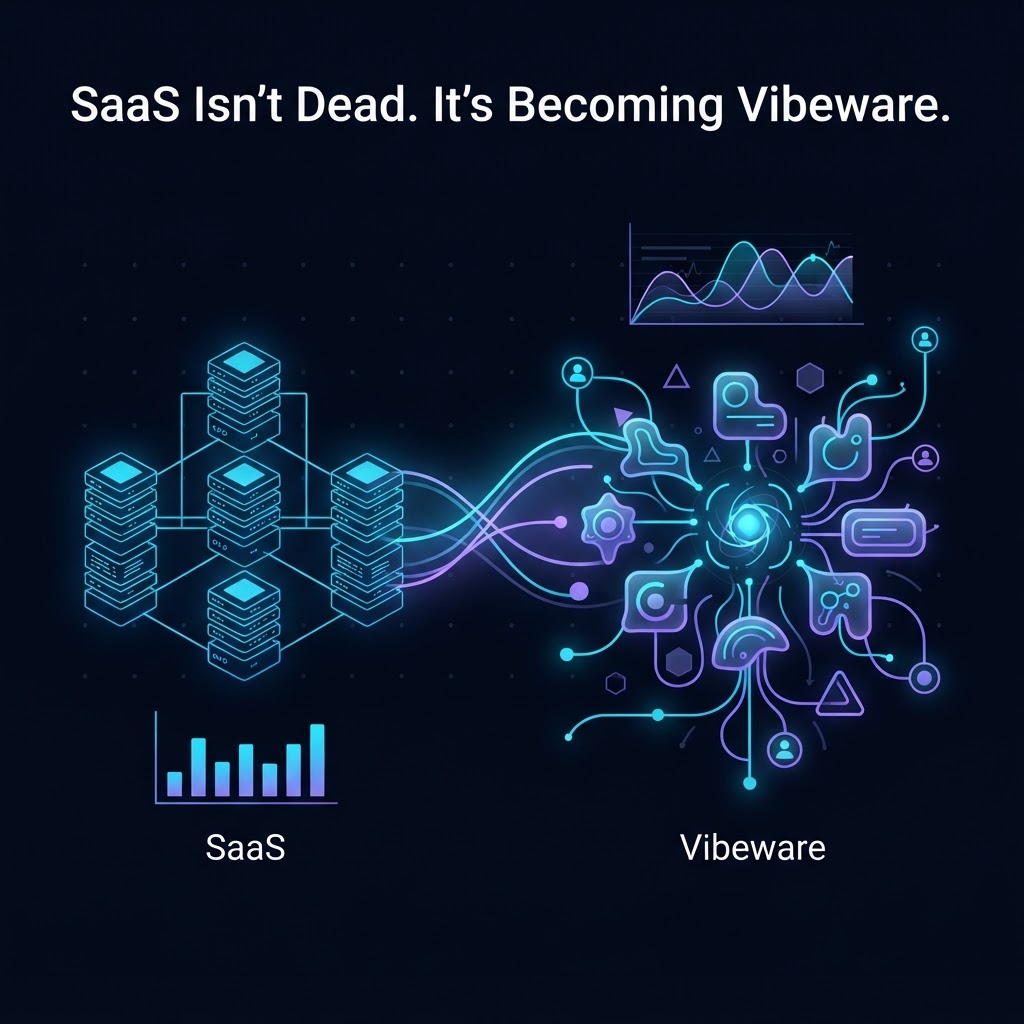
Everywhere I look lately, someone is declaring that SaaS is dead.
AI is going to replace traditional software. Subscriptions are going away. Anyone can build applications now, so why would we continue paying for software?
I understand the excitement. In fact, I share much of it.
But having spent the past year fundamentally rethinking how we build software, I've come to a different conclusion.
SaaS isn't dead. It's evolving into something dramatically better for the people who use it.
And we've seen this kind of transformation before.
Remember When Everyone Shared a Telephone?
Think back to when telephones were attached to walls.
A household had a telephone line, usually one phone number, and everyone shared the same device and service.
You could make calls, receive calls, and communicate with people. The functionality was relatively standardized, and the service was built around the household or physical location rather than the individual.
Then mobile phones arrived.
Suddenly, the telephone wasn't something you went to. It was something that belonged to you.
You had your own phone, your own number, your own contacts, and eventually your own applications, settings, and experiences.
The pricing model changed, too.
We moved through a period when mobile usage was frequently charged by the minute, with different plans, allowances, and charges depending on how we used the service.
And in many cases, we paid considerably more for that flexibility.
But here's the important part.
We didn't stop using telephones. We completely reimagined what having a telephone meant.
The ability to communicate anywhere, anytime, on our own terms was worth far more than the limitations of the traditional shared telephone.
Eventually, mobile phones became smartphones, and the possibilities expanded beyond anything we could have imagined when they first appeared.
Today, nobody thinks of their smartphone as simply a replacement for a landline.
It's their own personalized platform for communication, work, entertainment, information, and countless other capabilities.
And that's exactly how I see the evolution of SaaS.
Today's SaaS Is the Shared Landline
Traditional SaaS has delivered tremendous value.
It made enterprise-class software accessible without requiring businesses to build and maintain their own infrastructure.
It gave us cloud-based platforms, continuous updates, connected applications, and the ability to scale without massive upfront investments.
Those are enormous achievements.
But it also created a fundamental limitation.
We all have to use essentially the same software.
Sure, there are different roles, permissions, dashboards, configurations, and increasingly sophisticated ways to customize an application.
But at its core, the experience is designed by the software vendor.
The navigation, workflows, screens, interactions, and functionality are largely determined by what the vendor believes will satisfy the majority of its customers.
And understandably so.
Traditional software companies need to build products that meet the needs of as many customers as possible.
If they can satisfy 80% of the market with a standardized product, they have a commercially viable business.
But what happens to the other 20%?
What happens to the people who work differently, think differently, or have ideas that don't fit neatly within the standard application?
They adapt.
They work around the limitations.
They purchase additional modules, upgrade subscriptions, export data to spreadsheets, or introduce another application to fill the gaps.
And everyone continues sharing essentially the same software experience.
Just like everyone used to share the same telephone.
Vibeware Changes Who the Software Is Built For
This is where I believe AI fundamentally changes the equation.
For the first time, we're approaching a point where software doesn't have to present the same experience to everyone.
This has become one of the most interesting things we're exploring as we evolve ForecastWorx.
We started with a fairly traditional approach to building a business application: understand the processes, design the workflows, build the interfaces, and deliver a consistent experience.
But the more we've incorporated AI into how we develop and operate our platform, the more we've begun questioning whether that traditional approach should define the future.
Why should a buyer, a demand planner, an inventory manager, and a business owner all have to interact with the same application in essentially the same way?
They share information, but they don't share the same responsibilities, decisions, or priorities.
Imagine a business running on a single platform with shared data, business rules, security, and operational processes.
But instead of requiring everyone to use the same standardized user interface, each person has an experience built around exactly what they need to accomplish.
- A buyer focuses on supplier opportunities, purchase orders, costs, and replenishment decisions.
- A demand planner focuses on forecast accuracy, demand patterns, promotions, and future requirements.
- An inventory manager focuses on availability, exceptions, service levels, and working capital.
- The business owner focuses on performance, strategic opportunities, and where the company needs attention.
All working on the same underlying platform.
All using the same trusted business data.
But each interacting with the system in a way that makes sense for them.
And here's where it gets even more exciting.
What if those experiences weren't fixed?
What if a user could simply describe what they wanted to accomplish, and AI could create or adapt the interface, workflow, and supporting functionality?
No waiting for a vendor.
No submitting feature requests.
No hoping that the next product release addresses a specific need.
The platform evolves with the person using it.
That's Vibeware. Software shaped around the user, rather than the user being shaped around the software.
And it's increasingly influencing how we think about the future of ForecastWorx.
From SaaS to VaaS: Vibeware as a Service
I believe this evolution could give rise to a new model.
VaaS: Vibeware as a Service.
Not the disappearance of SaaS, but its natural progression.
The underlying platform still matters enormously.
Businesses still need secure infrastructure, reliable data, integrations, consistent business rules, governance, auditability, and dependable operations.
In fact, as AI becomes more capable of creating and changing software experiences, those foundations become even more important.
We've learned this firsthand.
As ForecastWorx has evolved, we've increasingly separated the intelligence and business logic that power the platform from the ways people interact with it.
The forecasting models, inventory calculations, replenishment decisions, integrations, and underlying data need to remain consistent and reliable.
But the experience of accessing that intelligence doesn't necessarily have to be identical for everyone.
That's a distinction I believe will become fundamental to the next generation of business applications.
Instead of selling access to a standardized application, a VaaS provider delivers an adaptable business platform capable of supporting individualized experiences.
You might have ten people in a company using the same platform, but ten very different interfaces, workflows, and ways of working.
And those experiences could continuously evolve as responsibilities, requirements, and opportunities change.
The value is no longer simply the number of users who can log in.
It's what each user can accomplish.
This creates a completely different way of thinking about how software is designed, delivered, and monetized.
What Happens to Subscription Pricing?
This is another area where I see parallels with the evolution of telephony.
Traditional SaaS pricing is largely built around subscriptions.
Per user. Per month. Per feature tier.
- Need more functionality? Upgrade.
- Need another user? Pay more.
- Need an advanced capability? Purchase an additional package.
It's a pricing model that made sense when software functionality was relatively fixed and vendors could define what each subscription included.
But what happens when AI allows every user to create, modify, and expand their own software experience?
Suddenly, the traditional subscription model becomes less aligned with the value being delivered.
This is something we're thinking about ourselves as we consider how AI will influence the long-term evolution of ForecastWorx.
If one customer uses AI occasionally to understand their forecasts, while another relies on AI to continuously analyze exceptions, evaluate opportunities, and guide operational decisions, should they necessarily be paying based on the same traditional user subscription?
Perhaps not.
We may see pricing shift toward AI consumption, automation execution, processing volume, or measurable business outcomes.
Perhaps a business pays for the underlying platform and then for the AI resources it consumes.
Perhaps certain capabilities are priced based on usage rather than whether a customer has purchased the right subscription tier.
Or perhaps entirely new hybrid models emerge.
I don't think there's one obvious answer yet.
And I certainly don't think AI makes software free. Infrastructure, development, compute, security, and maintenance still have real costs.
But I do think the economics are changing.
Just as mobile telephony moved through usage-based pricing before evolving into the data and service plans we recognize today, software pricing may go through its own transformation.
We may stop paying primarily for access to features and start paying for the value and capabilities we actually use.
And that's a much more interesting proposition.
The Real Breakthrough Isn't Personalization. It's Freedom.
It's tempting to think this is simply about allowing users to customize their screens.
It's much bigger than that.
Traditional software largely determines what's possible before the user ever logs in.
The vendor decides what features to build, which processes to support, and which innovations make commercial sense.
Customers operate within those boundaries.
Vibeware has the potential to reverse that relationship.
Instead of asking what the software allows us to do, users can begin asking what they actually want to accomplish.
We're already experiencing the early stages of this shift through Nova, the AI planning capability we're developing within ForecastWorx.
The interesting part isn't simply that users can ask questions about their business.
It's the direction that interaction can take.
- What if a planner wants to understand why inventory is increasing at one location?
- What if a buyer wants to evaluate a supplier opportunity against future demand, inventory requirements, and available budget?
- What if a business owner wants to understand the financial consequences of a decision before it's made?
These aren't necessarily requests for another report or dashboard.
They're requests to accomplish something.
And when AI can understand the intent, access the appropriate business context, and guide or execute an authorized action, the traditional boundaries of the software interface begin to matter less.
That's where we're investing our thinking.
Not simply adding AI features to existing software, but exploring how AI can fundamentally change the relationship between a user and the platform.
Of course, not every user should be able to change shared business rules or production systems without appropriate controls. Individual flexibility still needs to operate within a governed platform.
But that doesn't diminish the opportunity.
It makes the model sustainable.
The breakthrough isn't giving everyone unlimited control over the software. It's giving everyone the freedom to improve how they work without compromising the platform everyone depends on.
Imagine If Your Smartphone Worked Like Traditional SaaS
Here's another way to think about it.
Imagine buying a smartphone where the manufacturer decided which apps everyone could use, how every screen was arranged, and which workflows were available.
Imagine having to upgrade to a more expensive monthly package because you wanted to organize your phone differently or use an application that wasn't included in your subscription.
And imagine every person in your company having to use essentially the same phone experience because that's how the manufacturer designed it.
It sounds ridiculous today.
Yet that's surprisingly close to how we still approach much of our business software.
We've come to accept that our personal technology adapts to us.
Why shouldn't our business technology do the same?
In fact, wouldn't that flexibility be even more valuable in business, where differences in how people work can create real competitive advantages?
The phone didn't stop being a phone when it became personal.
It became infinitely more useful.
And I believe software is approaching a similar moment.
The Next Generation of SaaS Could Be Better Than We Imagine
I don't believe the future belongs exclusively to businesses building all their own software.
And I don't believe traditional SaaS providers will simply disappear.
Quite the opposite.
I believe the companies that embrace AI-driven adaptability have an extraordinary opportunity to deliver more value than ever before.
They already have much of the infrastructure, domain expertise, integrations, and trusted data models that businesses need.
What they have to reconsider is the assumption that every customer, and every user, should experience their platform in essentially the same way.
That realization has been transformative for us.
We're no longer thinking about ForecastWorx solely as a collection of features, screens, and workflows that customers subscribe to.
We're increasingly thinking about it as an intelligent business platform that should adapt to the people using it, help them make better decisions, and continuously expand what they can accomplish.
That's a very different ambition from simply building better forecasting or inventory management software.
And while we're still learning and building toward that vision, each advancement in AI makes it feel more achievable.
The winners may be the companies that stop treating their user interface as a fixed product and start treating it as something that can evolve with each user.
Where the underlying platform provides consistency and trust, while AI enables individuality and innovation.
Where the software no longer needs to satisfy only the common 80% because the remaining 20% can be addressed through adaptable experiences and capabilities.
And where customers increasingly judge a platform not by the length of its feature list, but by how effectively it helps them accomplish what matters.
That's the evolution I find so exciting.
We're Not Watching the Death of SaaS
We're watching the beginning of something that could be much bigger.
When mobile phones arrived, people debated costs, coverage, reliability, and whether anyone really needed a phone everywhere they went.
What seemed like an expensive alternative eventually transformed how the world communicates.
The economics changed. The technology improved. The possibilities expanded.
And the old limitations became almost impossible to imagine living with.
I believe AI and Vibeware could have a similar effect on business software.
We may look back one day and wonder why we accepted software that forced every user into essentially the same experience, regardless of what they actually needed.
Why we purchased bundles of functionality rather than capabilities aligned with our work.
And why we allowed someone else's product roadmap to define the boundaries of our own creativity.
For us, this isn't simply a prediction about where the software industry might go.
It's increasingly the philosophy guiding what we're building, how we're building it, and what we believe ForecastWorx can become.
And that's what makes this moment so exciting.
SaaS isn't dead.
It's evolving from software designed for everyone into software that can be designed for each of us.
- From shared experiences to individual experiences.
- From fixed functionality to adaptable capabilities.
- From subscriptions built around access to business models increasingly aligned with usage and value.
- From SaaS to VaaS.
Just as the telephone evolved from something we shared into something uniquely our own, I believe software is beginning the same transformation.
And if the history of telephony teaches us anything, it's that the most exciting possibilities probably aren't the ones we can imagine today.
They're the ones we'll discover once we're no longer constrained by how things used to work.
That's the shift.
"We're not just watching the shift. We're building in it."
The Takeaway
Article summary
SaaS is not dying but evolving into Vibeware where AI creates software experiences tailored to individual user needs. This shift moves us from standardized platforms toward adaptable tools that better align with actual business goals.

Greg Marmulak
Founder, ForecastWorx