Was Excel the Best Software Ever Built? Vibeware Might Finally Be the Answer to Excel
Why the future of enterprise software isn't about giving everyone the same experience. It's about giving everyone the freedom of Excel without sacrificing the integrity of a shared system.
By Greg Marmulak · 2026-11-10
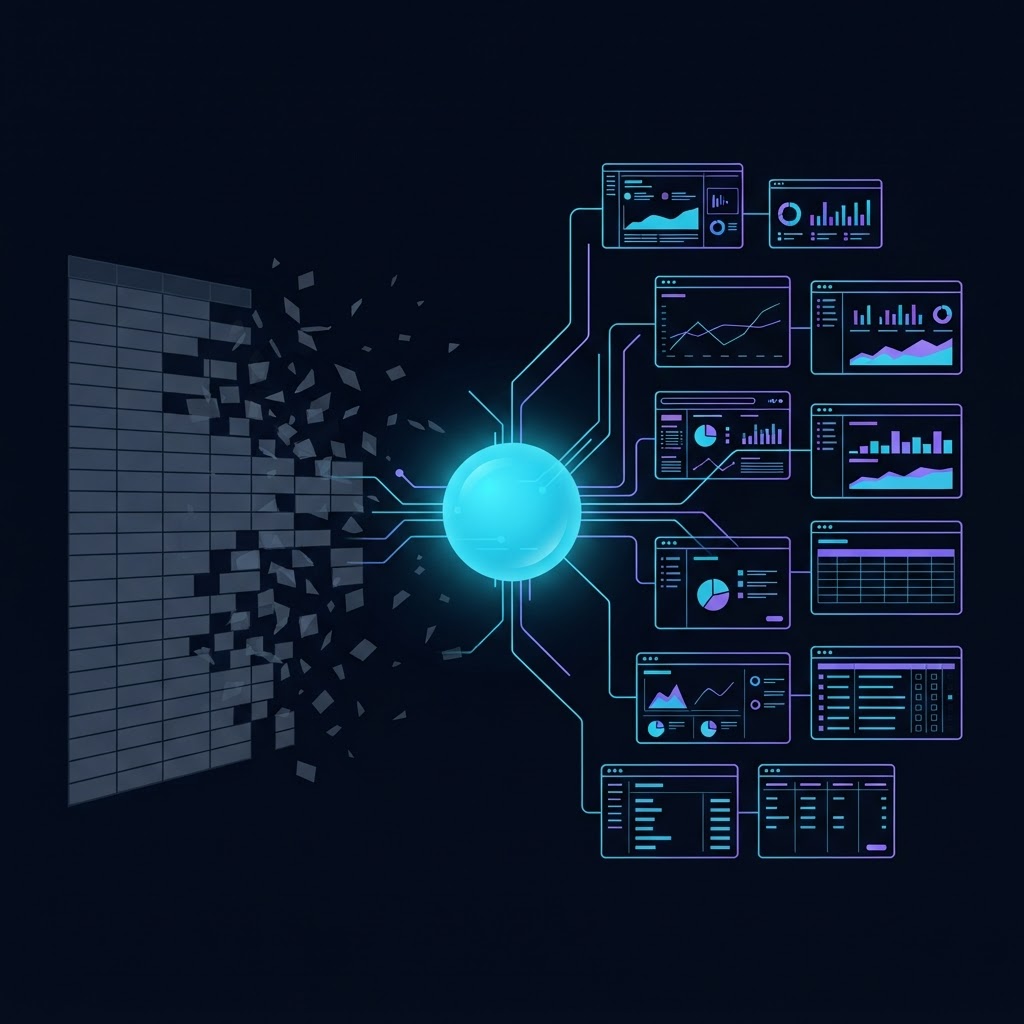
I've said something for years that might surprise people who know I've spent much of my career selling, implementing, and building enterprise software.
I believe Microsoft Excel is one of the greatest pieces of software ever created.
Not because it has the most sophisticated architecture, the most advanced analytics, or the best enterprise controls.
But because it gives people something that most business software never has.
Freedom.
Give someone Excel, and they can build almost anything they need.
A financial model. An inventory plan. A sales forecast. An assortment plan. A budget. An open-to-buy model. A process that nobody else in the company has even thought of yet.
They decide how it looks, how it works, what information matters, and how they want to interact with it.
They don't need a software vendor to tell them which workflow to follow.
They simply build what makes sense to them.
And there's something incredibly powerful about that.
But Excel has always had one enormous problem.
The Freedom of Excel Came at a Cost
I used to call it Excel bloat.
Anyone who's worked on large enterprise planning projects knows exactly what I'm talking about.
Spreadsheets everywhere.
Multiple versions of the same workbook.
One person maintaining a forecast in one file while somebody else updates an inventory plan in another.
Complex formulas linking worksheets together.
Business logic buried across hundreds of cells.
And eventually, nobody can confidently explain where a number came from, which version is correct, or what happens if somebody changes a formula.
The problem wasn't that Excel wasn't powerful enough.
It was that Excel made it too easy for everyone to build their own version of the truth.
For an individual, that flexibility was extraordinary.
For an organization trying to coordinate planning across departments, locations, products, and people, it could become a nightmare.
And that's where enterprise software came in.
We Solved the Data Problem by Taking Away the Freedom
For years, I sold and implemented enterprise software with a message I genuinely believed in.
Get out of Excel.
Centralize your data.
Standardize your processes.
Establish consistent business rules.
Create a single source of truth.
And give everyone a common system to work in.
It was a compelling proposition.
And in many ways, it was absolutely the right thing to do.
When organizations replaced disconnected spreadsheets with centralized enterprise applications, they gained visibility, consistency, accountability, and the ability to coordinate their operations.
But there was a trade-off we didn't talk about nearly enough.
We solved the problem of decentralized data by standardizing the way everyone had to work.
Instead of allowing people to build their own experiences, we gave them predefined screens, menus, workflows, reports, and processes.
The software vendor decided how the application should work.
And the users had to adapt.
I remember spending countless hours helping companies redesign their processes around how a particular application was built.
We called it standardization.
We called it best practices.
We called it operational efficiency.
And much of the time, those descriptions were justified.
But looking back, I wonder how much individual creativity and productivity we sacrificed along the way.
We had finally solved the problem of everyone having their own spreadsheet.
But we'd also taken away much of what made Excel so valuable in the first place.
Give 10 People Excel and You'll Get 10 Different Solutions
Here's an experiment I've seen play out countless times throughout my career.
Give ten people the same business problem.
Give them the same data.
Ask them to solve it using Excel.
What happens?
You'll probably get ten different spreadsheets.
Different layouts.
Different calculations and formulas.
Different ways of presenting the results.
Different ways of navigating the information.
Some people want detailed tables.
Others prefer charts.
Some want to start with the financial impact and drill into the operational details.
Others want to start with individual products, customers, or locations and work their way up.
And here's the interesting part.
They might all arrive at the same correct answer.
The difference isn't necessarily the outcome.
It's how each person thinks through the problem.
That individuality is something traditional enterprise software has struggled to accommodate.
And it's particularly obvious in the world of planning.
I've Never Seen Two Planners Think Exactly Alike
Over the years, I've seen more versions of open-to-buy planning and assortment planning than I could possibly count.
Every company has its own approach.
Every planning team has its own preferences.
And often, even people working within the same organization want to see and interact with information differently.
One merchandise planner wants to start with sales, margin, inventory investment, and financial targets.
Another wants to understand the assortment by product category, season, brand, and location.
Someone else wants to focus on exceptions, opportunities, or where inventory investment is producing the greatest return.
They might all be working toward the same business objective.
They might all be using the same underlying data.
And they might all be following the same financial and operational rules.
But they don't necessarily think about the problem in the same way.
So why have we spent decades insisting that they use essentially the same software interface?
Why should ten people with different responsibilities, experiences, and ways of thinking be forced into one predefined workflow?
I've asked myself that question increasingly often as we've continued building ForecastWorx.
And I think AI is finally giving us an answer.
What If We Could Have the Best of Both Worlds?
Imagine taking everything people love about Excel.
The flexibility.
The creativity.
The ability to organize information however they want.
The freedom to experiment, rearrange, calculate, visualize, and interact with data in ways that make sense to them.
Now imagine removing the biggest problems associated with that freedom.
No disconnected spreadsheets.
No competing versions of the truth.
No duplicated business logic scattered across workbooks.
No uncertainty about which calculations are correct.
Instead, everyone works from one centralized platform.
The data is shared.
The calculations are governed.
The business rules are consistent.
The security and permissions remain intact.
But the user experience?
That belongs to the individual.
A planner could have an interface designed around seasonal merchandise decisions.
A buyer could have a completely different experience focused on supplier performance, replenishment opportunities, and purchase orders.
An inventory manager could work almost entirely through exceptions and recommended actions.
And an executive could have a simplified view focused on business performance, financial impact, and strategic decisions.
All working from the same platform.
All operating against the same trusted data and calculations.
But each person interacting with that platform in a way that suits them.
That's the opportunity I see with Vibeware.
Not simply using AI to build software faster.
Using AI to fundamentally change who gets to decide how software should work.
The User Experience Keeps People Using Software. The Backend Makes It Possible to Keep Using It.
This is an idea I've become increasingly passionate about.
User experience is what keeps people using software. The backend is what allows them to keep using it.
Both are essential.
A beautiful, intuitive application that produces unreliable calculations or corrupts business data isn't useful.
But a technically brilliant platform that people find frustrating, confusing, or difficult to use isn't delivering its full potential either.
For decades, enterprise software has invested heavily in the underlying architecture, data models, calculations, business rules, and operational processes.
And rightly so.
Those capabilities are what make enterprise systems dependable.
But the user interface has typically remained something designed centrally and delivered to everyone in largely the same form.
AI changes what's possible.
What if the core platform stayed consistent, while the user experience became adaptable?
What if someone could describe how they wanted to work and have AI help create an interface around their needs?
What if that experience could evolve as their role, responsibilities, or preferences changed?
And what if those improvements could happen without compromising the integrity of the underlying system?
That's a fundamentally different model.
The backend provides stability.
The user experience provides individuality.
And the combination creates software that people actually want to use.
This Is What We're Building Toward With ForecastWorx
As we've continued developing ForecastWorx, this concept has increasingly influenced how we think about the platform.
We have sophisticated planning engines and business processes that need to remain reliable and consistent.
Demand forecasting.
Inventory optimization.
Replenishment planning.
Open-to-buy.
Assortment planning.
Supplier planning.
These aren't areas where we want ten people independently inventing ten different versions of the same calculation.
We need a common source of truth.
We need consistent business rules.
We need planning results that can be trusted across the organization.
But that doesn't mean everyone should have to interact with those results in the same way.
The more we've worked with AI, particularly as we develop Nova, our AI planning capability, the more we see an opportunity to separate the intelligence of the platform from the experience of using it.
A demand planner might want to explore forecast accuracy and seasonality through interactive visualizations.
A buyer might prefer a prioritized list of replenishment recommendations, with the ability to understand and act on each opportunity.
A merchandise planner might want to build an entirely different open-to-buy experience based on how they organize their categories, financial plans, and inventory investments.
And a business owner might simply want to ask what changed, why it matters, and what should be done next.
Why shouldn't all of those experiences exist within the same platform?
And why shouldn't users be able to influence how those experiences evolve?
That's what we're building toward.
Not ten separate applications.
Not ten competing versions of business logic.
One intelligent platform with the flexibility to support ten different ways of working.
Standardize the Truth. Personalize the Experience.
I think this might be one of the most important principles for the next generation of enterprise software.
Standardize the truth. Personalize the experience.
It's a simple idea, but it changes how we think about software architecture and product design.
The core business logic shouldn't become a free-for-all.
If two planners are looking at the same inventory position, they should be working from the same underlying facts.
If an open-to-buy calculation follows an approved financial methodology, its result shouldn't change simply because one person prefers a different dashboard.
If a replenishment recommendation is based on demand, supply, lead times, and inventory policies, those calculations should remain consistent.
But the way users explore that information, interpret it, organize it, and work with it?
Why should that be standardized?
We should be able to distinguish between what must remain consistent and what can be personalized.
And that distinction is critical.
A personalized interface doesn't mean users can bypass security, override business rules, or manipulate shared data without authorization.
Nor does it mean every AI-generated workflow should immediately be trusted in production.
The platform still needs guardrails, permissions, validation, auditability, and governance.
But within those boundaries, there's enormous room for creativity.
We don't need to sacrifice enterprise integrity to give people the freedom of Excel.
And for me, that's one of the most exciting possibilities AI has introduced.
The Most Expensive Software Is the Software That Isn't Used
We have a saying at ForecastWorx that captures much of our philosophy.
The most expensive software is the software that isn't used.
I've believed that for years.
I've seen companies invest enormous amounts of money implementing sophisticated applications, only to discover that adoption never reaches the levels they expected.
The technology works.
The calculations are correct.
The functionality exists.
But people continue exporting information to Excel.
They build their own reports.
They create workarounds.
They maintain spreadsheets alongside the enterprise application because it's easier to work the way they want.
Think about what that tells us.
After all the money spent buying and implementing software designed to replace Excel, people still return to Excel because it gives them control over their experience.
Maybe we've spent too much time asking users to change.
And not enough time asking why the software can't change for them.
That's the paradigm shift I believe Vibeware introduces.
Instead of demanding that everyone fit into the same predefined experience, we can begin building experiences around individuals.
And when users have software that feels natural, intuitive, and tailored to their work, they're far more likely to use it.
That matters because adoption isn't simply a technology metric.
It's what determines whether the investment actually delivers business value.
What If Every User Helped Make the Software Better?
Here's where I think the opportunity becomes even more interesting.
Imagine ten people using the same planning platform.
Each has a different interface.
Each has their own preferences.
Each has discovered ways to make their work more efficient.
Traditionally, those differences might have been viewed as a problem.
A lack of standardization.
Too much customization.
Too difficult to maintain.
But what if we started viewing those differences as a source of innovation?
What if the way one planner organizes their work could inspire an entirely new experience for others?
What if an inventory manager develops a better way to identify exceptions?
What if a buyer discovers an approach to evaluating purchase recommendations that helps the rest of the organization?
What if the platform could learn from those ideas, validate them, and make the best improvements available to everyone?
Suddenly, users aren't simply consuming software.
They're contributing to its evolution.
That doesn't mean every personal preference should become a global feature.
It means software providers can learn from the diversity of how people work rather than trying to eliminate it.
The best ideas can be shared.
Successful workflows can become reusable.
And the platform can continuously improve because its users are helping shape what it becomes.
I find that possibility incredibly exciting.
Maybe We Had the Right Idea All Along
Looking back, I don't regret selling and implementing enterprise software that replaced spreadsheets.
The problems we were solving were real.
Businesses needed centralized data.
They needed consistent processes.
They needed reliable calculations.
They needed accountability and control.
And enterprise software delivered much of that.
But I now believe we made an assumption that wasn't necessarily true.
We assumed centralized data required a centralized user experience.
We assumed consistency meant everyone had to work the same way.
And we assumed flexibility was something to limit because it threatened standardization.
Maybe that was simply a consequence of the technology available at the time.
Building and maintaining individualized interfaces for every user would have been prohibitively expensive and operationally difficult.
But AI is changing those economics.
And when the cost and complexity of creating personalized experiences fall dramatically, we can begin questioning assumptions that have shaped enterprise software for decades.
Maybe the real objective was never to get people out of Excel.
Maybe it was to give them everything they loved about Excel without everything that made Excel difficult to manage at scale.
That's a very different perspective.
And it's one that has completely changed how I think about the future of software.
The Future Isn't One Interface for Everyone
I don't believe every user needs a different interface simply for the sake of being different.
Some people will love the standard experience.
Others will want something completely customized.
Some will prefer traditional navigation and dashboards.
Others will increasingly interact with software through AI, conversations, dynamically generated views, and automated workflows.
And that's the point.
The user should have the choice.
We shouldn't force individuality any more than we should force standardization.
The goal isn't to create ten interfaces because we have ten users.
The goal is to make sure all ten users can work in the way that makes them most effective.
If that means ten different experiences, so be it.
If they all want the same one, that's fine too.
What matters is that the underlying platform remains secure, consistent, and reliable, while the experience becomes something that can adapt.
No more square pegs and round holes.
No more forcing people to abandon the ways they naturally think and work just to accommodate the limitations of a software application.
And no more assuming that the vendor always knows the best way for every individual to accomplish their job.
We Might Finally Have What We Wanted All Along
For decades, we faced a trade-off.
Excel gave us flexibility, creativity, and personal control.
Enterprise software gave us centralized data, governance, and consistency.
We chose enterprise software because businesses needed control.
And we accepted a more standardized experience as part of that decision.
But what if we no longer have to choose?
What if we can give everyone the freedom to create their own experience while maintaining one trusted foundation for the entire business?
What if the user interface is no longer a fixed limitation of the product, but something that continuously evolves with the person using it?
And what if every person who uses the platform has the opportunity to make it better?
That's the future we're exploring with ForecastWorx.
And it's why I believe Vibeware represents something much more significant than a faster way to build applications.
It's the opportunity to return the freedom of software to the people who actually use it.
Excel showed us how powerful that freedom could be.
Enterprise software showed us why consistency and control matter.
AI may finally allow us to combine the best of both.
One source of truth. Unlimited ways to work.
And perhaps the most important benefit of all?
Software that people actually want to use.
Because at the end of the day, the most expensive software will always be the software that isn't used.
That's the shift.
"We're not just watching the shift. We're building in it."
The Takeaway
Article summary
Standardize the truth. Personalize the experience. ForecastWorx keeps one governed planning engine for forecasting, inventory, replenishment, and open-to-buy, while letting every planner work the way they think.

Greg Marmulak
Founder, ForecastWorx